
How to choose a POS display in four questions
Objective, duration, budget and channel: the four questions that frame any POS display decision, with a decision tree and a checklist for requesting a quote.
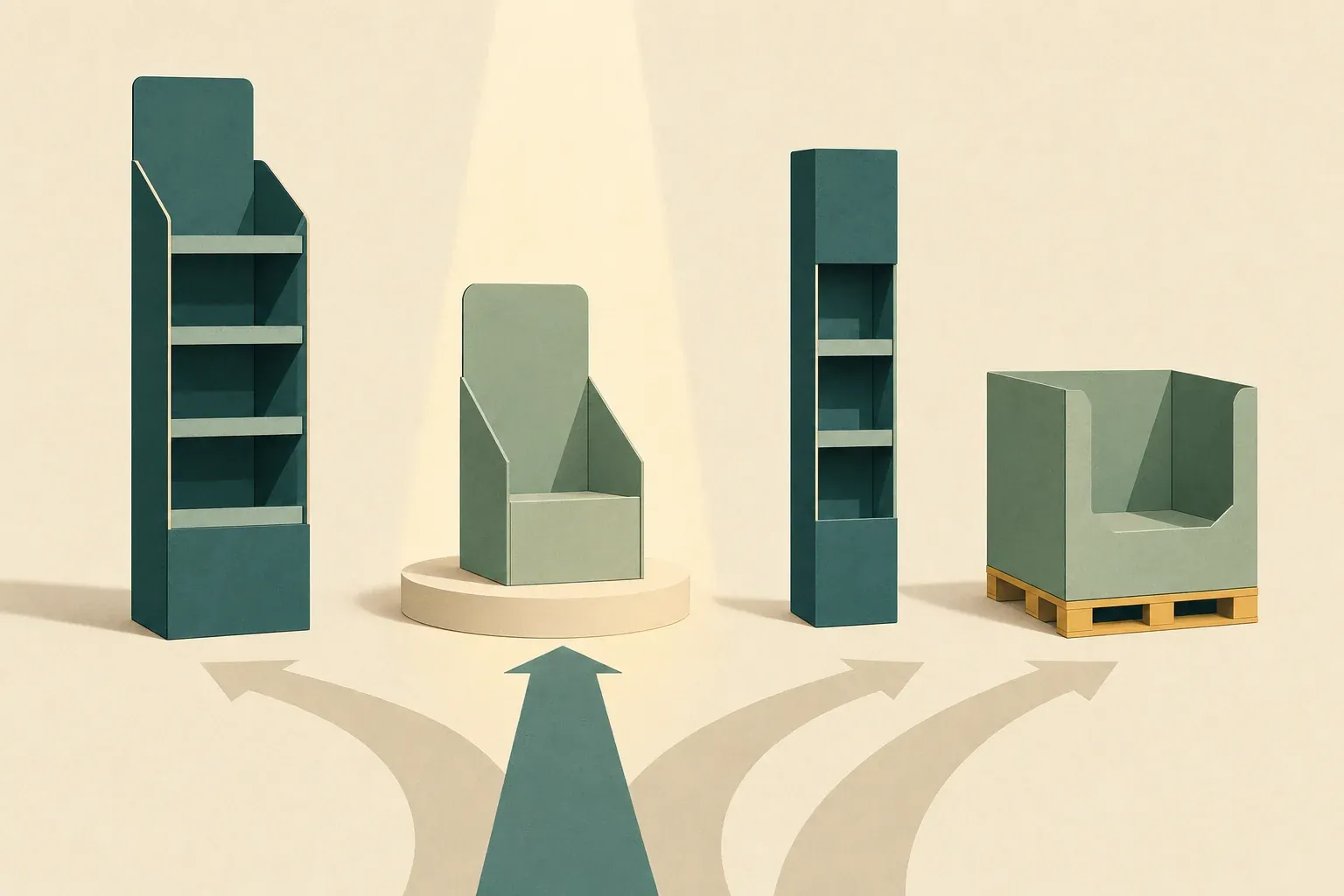
You know your campaign needs POS; the question is which. And this is where it is easy to go wrong: choosing a format that is too big, a material you don’t need or a badly calculated run makes the activation more expensive without selling more. The good news is that the decision resolves with four questions.
The four questions
Before looking at format catalogues, four things need to be clear. They frame 90 % of POS decisions: objective, duration, budget and channel.
What is the objective?
First, what the piece has to do with the product, because that is where the first major fork sits: there is POS that only communicates and POS that also holds product. It is the question that eliminates half the catalogue fastest.
If you only need to communicate — give a brand visibility, announce a promotion, signal a zone — the piece doesn’t need to hold product, it needs to be seen. That means totems, hanging displays and shelf-edge signage. Message pieces: light, visible, built to rise above the noise of the shelf.
If you also need to hold product — so the shopper takes the unit directly from the piece — POS becomes a support with a structure: counter displays near the till for impulse, floor units or pallet displays in the aisle to move volume. Here being seen is no longer enough: it has to take the weight and make restocking easy.
How long does it have to last?
Two to six weeks is a promotional display: cardboard, series production, fast assembly. Several months is a permanent display: reinforced structure, sometimes mixed materials, and a considerably higher unit cost amortised over the lifespan.
Getting this wrong is the most expensive mistake available. The materials guide covers where the switch sits.
What budget, across how many stores?
The number that matters is almost never the cost of the piece but the cost per store, transport and assembly included. A piece that costs more each but assembles in thirty seconds and ships flat can come out cheaper overall than a cheap piece that takes two hours and a full pallet.
At FMCG scale, every euro and every centimetre is multiplied by the store count. Logistics becomes a design decision, not an execution detail.
Which channel?
The format that works in a hypermarket doesn’t work in a perfumery. Shelf constraints, negotiable space and the way the product sells change completely:
- Large-format retail and food: floor units, pallet displays, gondola ends. Heavy traffic, dense product, daily restocking.
- Pharmacy and cosmetics: counter and window. Small spaces, finish read from close up, purchase often advised.
- Specialist retail: mixed, depending on floor area and the retailer’s planogram.
The decision tree, in short
- Does the piece hold product? No → totem, hanging display, shelf-edge signage. Yes → step 2.
- How much product, and at what weight? Little and light → counter. A lot or heavy → floor unit or pallet display.
- How long? Weeks → cardboard. Months → reinforced structure or permanent material.
- How many stores? Few → optimise the piece. Many → optimise assembly and transport before anything else.
The checklist for requesting a quote
Send these four things and the first price will be useful rather than approximate:
- The product: photo, dimensions, unit weight, number of units to present.
- The location: aisle, till, shelf, window, gondola end. With the retailer’s constraints if you have them.
- The number of stores and the countries involved.
- The installation date in store. That is what we build the whole production schedule back from.
With that, we come back within 24 working hours with a first price or with the questions needed to firm it up.