
POS display materials: which board, and which alternatives
A comparison of POS display materials: microflute, double-wall corrugated, compact board, and when to move to wood, metal or acrylic. With a decision table.
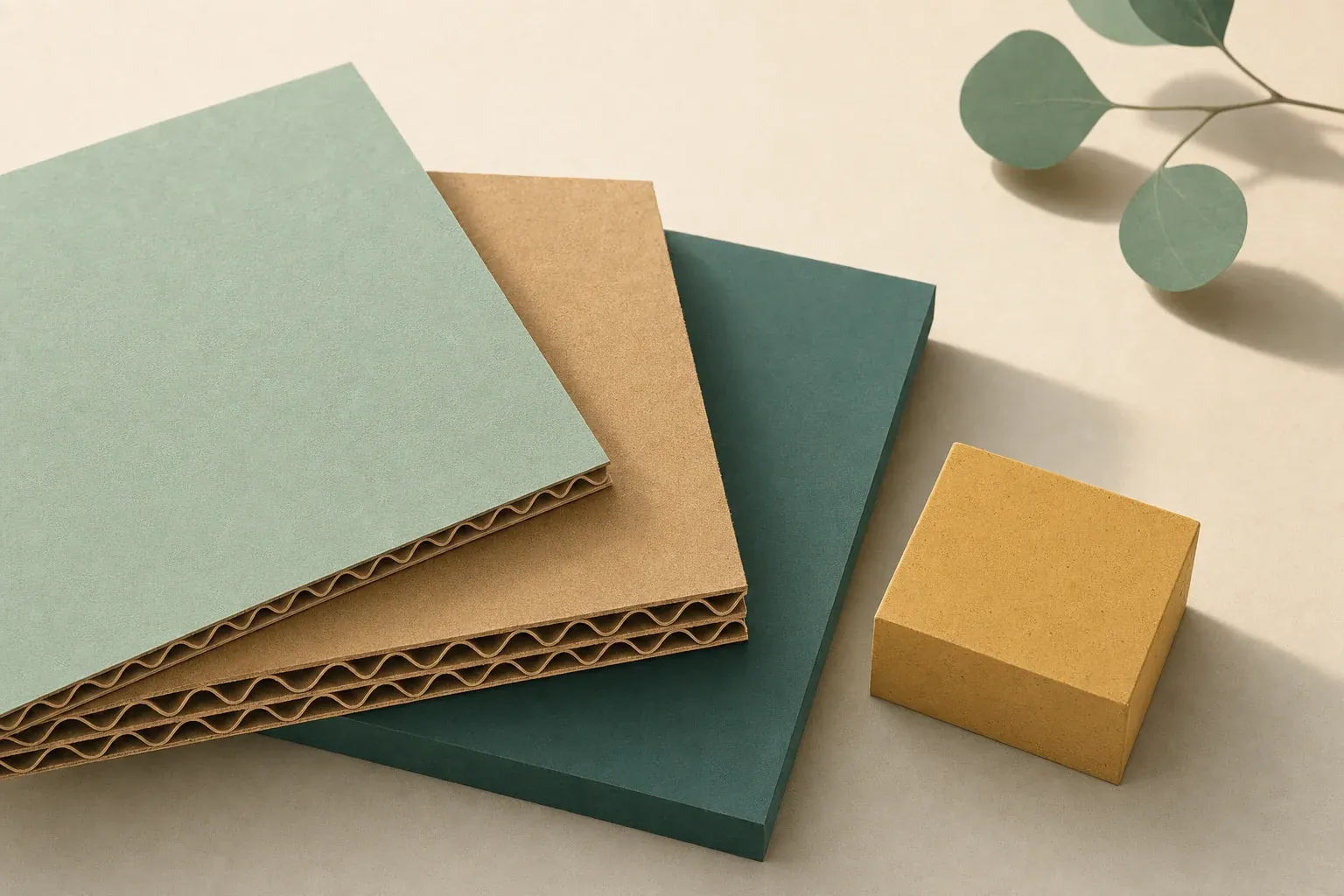
Choosing a POS display material looks like a technical decision, but it is really a campaign decision: how long the piece has to last, how much weight it has to carry, what image you want to project and what budget you have. Most in-store POS work is resolved in cardboard, but it is worth knowing why — and when it pays to move to a permanent material.
Why cardboard dominates temporary POS
Cardboard is the default material for promotional POS for four reasons that work together: it is light, it prints well, it recycles and it stays affordable. For an activation that lives as long as a campaign, no other material delivers all four.
Each one matters in store. Light cuts transport cost and lets one person assemble the display without tools. Prints well — especially on its smooth face — turns the support itself into the brand’s artwork, with no decals added. Recyclable fits the environmental targets most brands now carry and simplifies removal at the end of the promotion. And affordable makes it viable to produce hundreds of units for an activation that may last a few weeks.
The trade-off is durability: cardboard is built for the cycle of a campaign, not for years of traffic.
Microflute, double-wall and compact board
There is no such thing as “cardboard” in the singular. The difference lies in the flute: the corrugated inner sheet that provides rigidity at almost no weight. Depending on the height of that flute — codified by FEFCO as A, B, C, E, F — the board is thicker and stronger, or thinner and better to print.
| Flute | Flute height | Typical POS use |
|---|---|---|
| B | ≈ 2.4 mm | Structure, valances, reinforcement |
| E (microflute) | ≈ 1.2 mm | Display bodies and quality graphics |
| F / N | ≈ 0.5–0.8 mm | Cartons and small pieces |
When to use microflute
Microflute (E-flute) is the workhorse of cardboard POS: a fine flute giving a board around 1.5 mm thick, rigid for its weight, with a face smooth enough to print sharply. It is the ideal balance between structure and image, which is why it serves as the usual support for counter displays, floor-unit bodies and most promotional pieces.
It is our reference material for campaign formats, precisely because it takes assembly and in-store use while keeping the print clean. Finishes and lead times are covered on the microflute cardboard page.
When double-wall is needed
As soon as the piece carries real weight — a floor-unit base, a pallet display, a shelf loaded with tins or bottles — you stack two flutes. You lose in print fineness what you gain in strength, and it is a deliberate trade-off: quality graphics then concentrate on the visible parts, in microflute, while the structure moves to double-wall.
Compact board
No flute: a dense, thinner sheet that folds very cleanly. It is the material for cartons, gift boxes and small counter pieces, where the load is minimal and the finish is everything. See custom packaging.
When to move to a permanent material
Cardboard loses its advantage the moment the piece has to live for months. Three alternatives, with different logics.
Wood brings a warmth and a perceived quality cardboard doesn’t reach, and it lasts. It is heavier, costlier to transport and slower to produce. It works well in delicatessens, natural cosmetics and brand corners.
Metal is the choice for permanent POS in large-format retail: it takes years of traffic and restocking. High entry cost, amortised over the lifespan.
Acrylic gives a transparency and gloss that help when the product has to be seen from every angle. It scratches, it yellows over time and its recycling is considerably harder than cardboard’s — a point that weighs increasingly in the decision.
The decision table
| If your priority is… | The material |
|---|---|
| A campaign of a few weeks | Microflute |
| Carrying heavy product | Double-wall, with reinforcement |
| A premium finish at small format | Compact board |
| A piece that stays for months | Wood or metal |
| Seeing the product from every angle | Acrylic |
| The simplest recycling | Mono-material cardboard |
And the environmental side
This is an argument where cardboard is structurally favoured, not just in communication. According to Pro Carton, the recycling rate for fibre-based packaging in Europe sits at around 83 %, and cellulose fibres can be recycled many times before they are exhausted.
For a brand selling into the European Union, a mono-material cardboard piece is the simplest case to handle at end of life and the simplest to justify to a retailer.