
What are POS displays? Definition, formats and uses
POS displays, or point-of-sale displays: what the term covers, the main formats, what separates promotional from permanent, and how to choose.
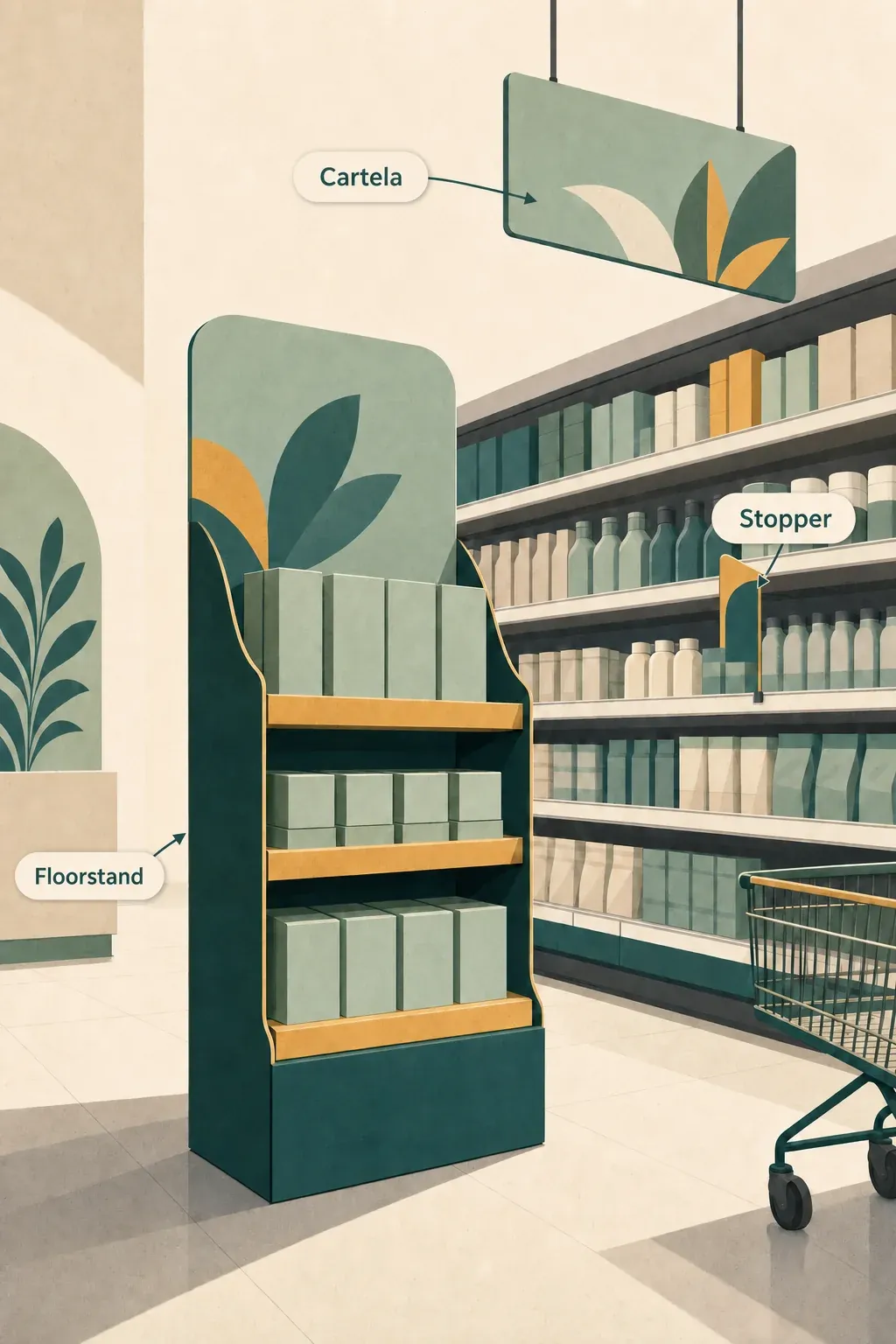
POS stands for point of sale. A POS display is any physical support installed in a store to put a product forward: a unit standing in the aisle, a shelf wrap, shelf-edge signage, a pallet display at the gondola end.
You will also see POP display (point of purchase), used interchangeably across most of the industry. In Spain and France the trade uses PLV — originally a French acronym for publicité sur le lieu de vente. The vocabulary travels because the craft is the same.
What POS displays actually do
A POS display is the only marketing lever that acts at the exact place and moment the decision is made. Everything that comes before it — outdoor, social, search — works upstream. POS works on the last metre.
Buying behaviour has changed a great deal: the shopper arrives far better informed than before, having compared prices and read reviews. According to data collected by POPAI Spain (2026), 63 % of Europeans already use AI to compare brands and prices before buying, and 38 % to decide directly what to take. But that research happens before walking in. The final choice, and above all the unplanned purchase, are still settled in front of the shelf. Which is exactly why the physical moment matters more, not less.
The main formats
There are dozens of variants, but four families cover most campaigns.
- The floor-standing unit — a vertical structure placed in the aisle. It gives the brand a location of its own, outside the shelf where it sits next to every competitor. The most visible format, and the most demanding on load.
- The counter display — a small format at the till, aimed at impulse purchase. The challenge isn’t size but the footprint you can negotiate with the retailer.
- The shelf wrap — the range is highlighted inside the existing planogram, without asking the store for new space. The easiest compromise to get accepted.
- The pallet display — high capacity, for volume promotions in large-format retail. It arrives filled and empties in place.
Each family is covered in detail in the guide to POS display types.
Promotional or permanent: the distinction that matters
This is the first thing to settle, before any conversation about creative, because it changes every sizing decision.
A promotional display lives for one activation — often two to six weeks. It has to be produced fast, cost little per store, and go up in a few movements. Cardboard is essentially unchallenged here.
A permanent display stays for months. It will be restocked dozens of times, knocked by trolleys, wiped down. It needs a considerably more robust structure, and sometimes mixed materials.
Getting the category wrong is the most expensive mistake in this trade: a promotional structure left in store for six months sags and damages the product’s image, while a permanent structure produced for a three-week promotion blows the budget for no return.
Why cardboard
Cardboard became the default because it combines three things that are rarely compatible: a cost that holds up at large run sizes, direct printing across the whole surface, and simple recycling through paper and board streams that already exist everywhere in Europe. According to Pro Carton, the recycling rate for fibre-based packaging in Europe sits at around 83 %.
Its limit is real: it carries the load it was sized for, and no more. Hence the importance of the loaded prototype, which remains the only genuine test. The material trade-offs are covered in the materials guide.
How to choose, in practice
Four questions frame 90 % of projects: which product (weight, format, units to present), which location (aisle, till, shelf, gondola end), how many stores, and how long the piece has to last.
Everything else — creative, finishes, exact material — follows from those answers. It is also why a serious first price is possible very quickly. The guide to choosing a POS display walks through the decision step by step.